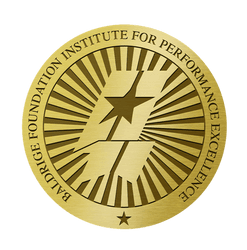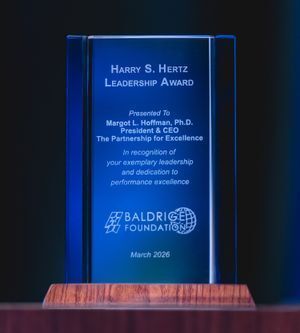
The award is a twelve-inch clear crystal with dark blue cylinders on the vertical edges and a clear crystal base. The award inscription is etched into the clear crystal face.
About the Award
The Harry S. Hertz (HSH) Leadership Award, authorized by the Baldrige Foundation Board of Directors in 2012, recognizes an individual whose behaviors provide a role model for others. While no one person in an organization can be credited with the achievement of excellence, this award will recognize and set forth role-model behaviors that have inspired, encouraged, challenged, and empowered others to achieve performance excellence. Award recipients will share how they lead their organizations and inspire their people to achieve high performance.
Recipients of the award personify the HSH Award Core Value Attributes and Leadership Behaviors: visionary leadership, customer-focused excellence, organizational and personal learning, valuing workforce members and partners, agility, managing for innovation, management by fact, societal responsibility, focus on results and creating value, and systems perspective. HSH Award Core Value Attributes and Leadership Behavior details are listed below.
This award recognizes disciplined, systems-based leadership aligned with core values. It does not recognize charisma or personality.
Who May Be Nominated
Anyone may nominate an individual to receive this award; no self-nominations are permitted.
Strong Nominees Demonstrate
- A clearly defined leadership approach or system
- Alignment between leadership, strategy, and operations
- Strong workforce engagement and development
- Ethical leadership and accountability
- Evidence of sustained organizational improvement
Requirements
- Demonstrated leadership behaviors and results consistent with the Baldrige Criteria for Performance Excellence®.
- Be willing to share their leadership practices as they relate to the Harry S. Hertz Leadership Award Core Value Attributes and Leadership Behaviors.
Role of Examples
Nomination essay examples should show:
- How leadership decisions are made
- How leadership practices are applied consistently
- Impact on organizational performance
Award Limits
- Up to one recipient may be recognized each year
- Award is not guaranteed and may be withheld
- An individual may not receive the award more than once
Ready to Nominate a Leader
- Learn more about How to Apply and Key Dates.
- Prepare the required submission information listed below.
- When ready to nominate a leader, select the "APPLY NOW" button, located at the top.
Submission Requirements
- Online Award Nomination Form
Fill out the nomination form in the online application.
- Biography or Curriculum Vitae
Nomination must include the nominee's biography or curriculum vitae.
- Nomination Essay (1,200 word limit)
The essay must address HOW the nominee approaches five of the HSH Leadership Award Core Value Attributes and Leader Behaviors (there are three required core values [Visionary Leadership; Systems Perspective & Ethics and Transparency] and two core values of the nominator’s choice). Please provide examples (the HSH Leadership Award Core Value Attributes and Leader Behaviors are listed below).
Questions and Online Application Help
awards@baldrigefoundation.org | 202.559.9195 | M-F, 9 AM–5 PM (ET)
HSH Leadership Award Core Value Attributes and Leadership Behaviors
Visionary Leadership
- Leads the organization in setting and owning organizational vision and values.
- Guides the creation of strategies, systems, and methods to ensure ongoing organizational success.
- Inspires the organization and partners to achieve high performance.
- Demonstrates authenticity, admitting to missteps and opportunities for improvement.
Systems Perspective
- Sets a systems perspective across the organization so that the organization and all its parts are viewed as a whole.
- Causes holistic thinking and cross-functional synthesis, alignment, and integration.
- Requires a focus on strategic direction and customers to improve overall performance.
- Leads with recognition of the larger ecosystem (partners, suppliers, customers, communities) in which the organization operates.
Customer Focused Excellence
- Builds a customer-focused culture and integrates customer engagement and loyalty as a strategic concept.
- Creates a focus on anticipating changing and emerging customer and market requirements.
- Ensures differentiation from competitors through the development of innovative offerings and unique relationships.
Valuing People
- Builds and reinforces an organizational culture that focuses on meaningful work engagement, accountability, development, and well-being of workforce members.
- Creates an organizational environment that is safe, trusting, and cooperative.
- Builds partnerships with internal and external people and stakeholder groups.
- Builds a culture of inclusivity that capitalizes on the diversity of the workforce and partners.
Organizational Learning and Agility
- Develops a capacity for rapid change and for flexibility in operations.
- Leads and inspires the organization to make risk and make transformational changes despite ever-shorter cycle times.
- Creates an empowered workforce that effectively develops and uses evolving organizational knowledge.
- Embeds learning in the way the organization operates.
Focus On Success
- Creates a focus on short- and longer-term factors that affect the organization and its future marketplace success, including needed core competencies and skills.
- Accomplishes strategic succession planning for leaders and workforce.
- Ensures that organizational planning anticipates future marketplace, economic, and technological influences.
Managing For Innovation
- Builds an environment where strategic opportunities are identified, and the workforce is supported to take intelligent risks.
- Fosters collaborative thinking among people who do not normally work together.
Management By Fact
- Compels the organization to measure performance both inside the organization and in its competitive environment.
- Uses data and analysis in operational and strategic decision making.
- Challenges the organization to extract larger meaning from data and information.
Societal Responsibility
- Acts as a role model for public responsibility and actions leading to societal well-being and benefit.
- Motivates the organization to excel beyond minimal compliance with laws and regulations.
- Drives environmental, social, and economic betterment of the community as a personal and organizational goal.
Ethics and Transparency
- Requires highly ethical behavior in all organizational activities and interactions.
- Leads with transparency through open communication of clear and accurate information.
- Builds trust in the organization and its leaders.
Delivering Value And Results
- Leads the organization to achieve excellent performance results.
- Defines and drives the organization to exceed stakeholder requirements and achieve value for all stakeholders.